Showing posts with label 2D5. Show all posts

Saturday, 1 January 2011

Theme 2 - Assignment 2 - Edward Western

Edward Henry Weston was born March 24, 1886, in Highland Park, Illinois.  He spent the majority of his childhood in Chicago where he attended Oakland Grammar School. He began photographing at the age of sixteen after receiving a Bull’s Eye #2 camera from his father. Weston’s first photographs captured the parks of Chicago and his aunt’s farm. In 1906, following the publication of his first photograph in Camera and Darkroom, Weston moved to California. After working briefly as a surveyor for San Pedro, Los Angeles and Salt Lake Railroad, he began working as an itinerant photographer. He peddled his wares door to door photographing children, pets and funerals. Realizing the need for formal training, in 1908 Weston returned east and attended the Illinois College of Photography in Effington, Illinois. He completed the 12-month course in six months and returned to California. In Los Angeles, he was employed as a retoucher at the George Steckel Portrait Studio. In 1909, Weston moved on to the Louis A. Mojoiner Portrait Studio as a photographer and demonstrated outstanding abilities with lighting and posing.) Weston married his first wife, Flora Chandler in 1909. He had four children with Flora; Edward Chandler (1910), Theodore Brett (1911), Laurence Neil (1916) and Cole (1919). In 1911, Weston opened his own portrait studio in Tropico, California. This would be his base of operation for the next two decades. Weston became successful working in soft-focus, pictorial style; winning many salons and professional awards. Weston gained an international reputation for his high key portraits and modern dance studies. Articles about his work were published in magazines such as American Photography, Photo Era and Photo Miniature. Weston also authored many articles himself for many of these publications. In 1912, Weston met photographer Margrethe Mather in his Tropico studio. Mather becomes his studio assistant and most frequent model for the next decade. Mather had a very strong influence on Weston. He would later call her, “the first important woman in my life.” Weston began keeping journals in 1915 that came to be known as his "Daybooks." They would chronicle his life and photographic development into the 1930’s.

This Image is one of Edward Westerns that I particularily like and enjoy looking at. It has great composition, striking tone changes and is an unbelievable picture considering it is of a simple cabbage leaf!


I have taken this image and used it as my inspiration in producing these images below:


Cabbage specs:

Nikon D300
ISO 200
Focal length 70mm
f5.3
Shutter speed 1/20sec


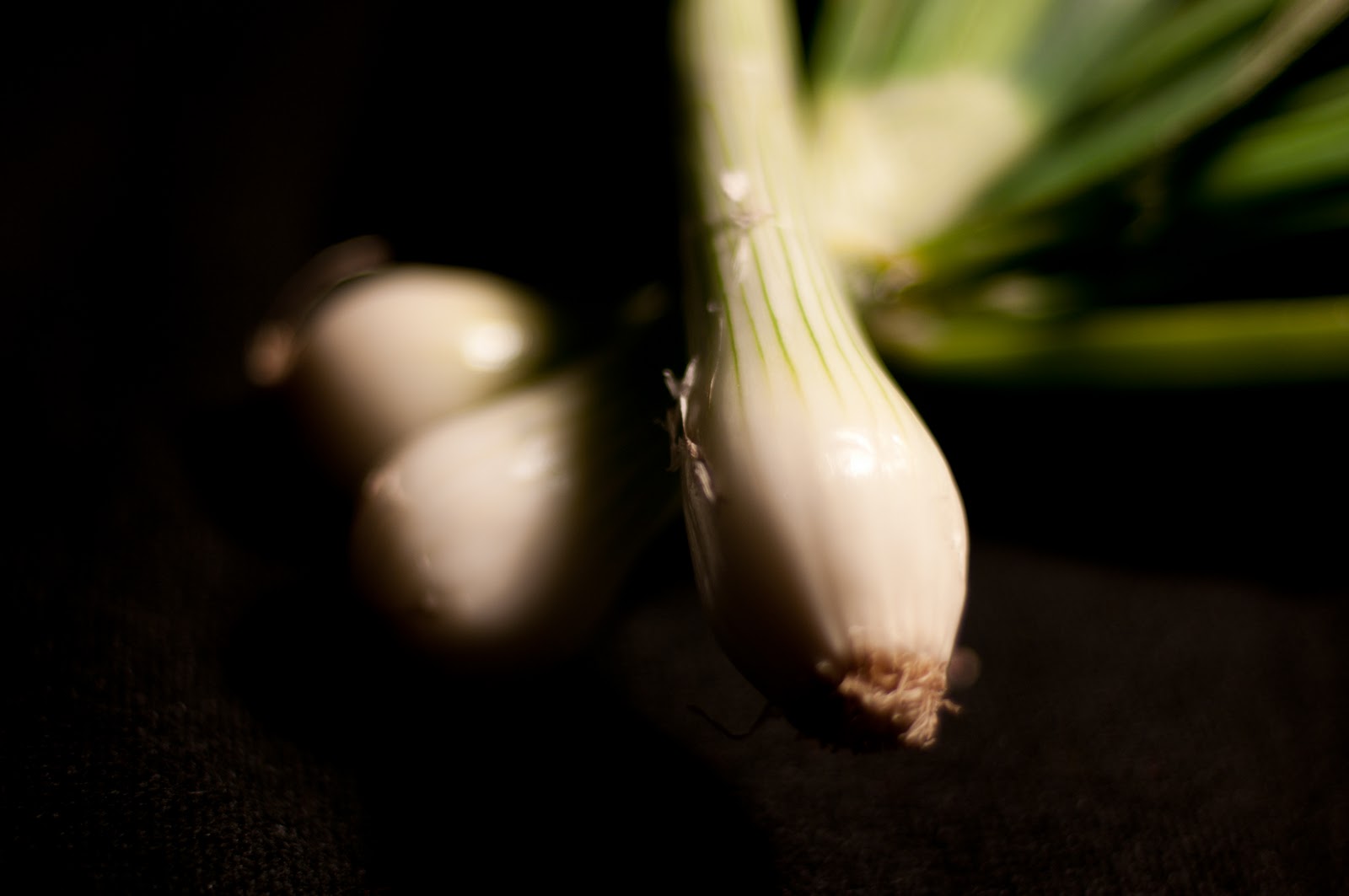
Onion Specs:

Nikon D300
ISO 200
Focal length 50mm
f1.4
Shutter speed 1/200sec


Tomato Specs:

Nikon D300
ISO 200
Focal length 50mm
f 5
Shutter speed 1/8sec


This is the set up that produced these images:


You can see that there is a simple tungsten light source that was used to create these images. Each object was placed on a black background cloth and shot from a variety of angles in order to capture a variety of focal points.

The light was securely fastened to a fixture using a strong clip and no drinks or fluids were in the vacinity in order to reduce the risk of fire. The entire 'set' was so small it produced virtually no health and safetly risks.

Equipment used:

Nikon D300
Single tungsten light source
Black background cloth
50mm lens
18-135 lens

Post production

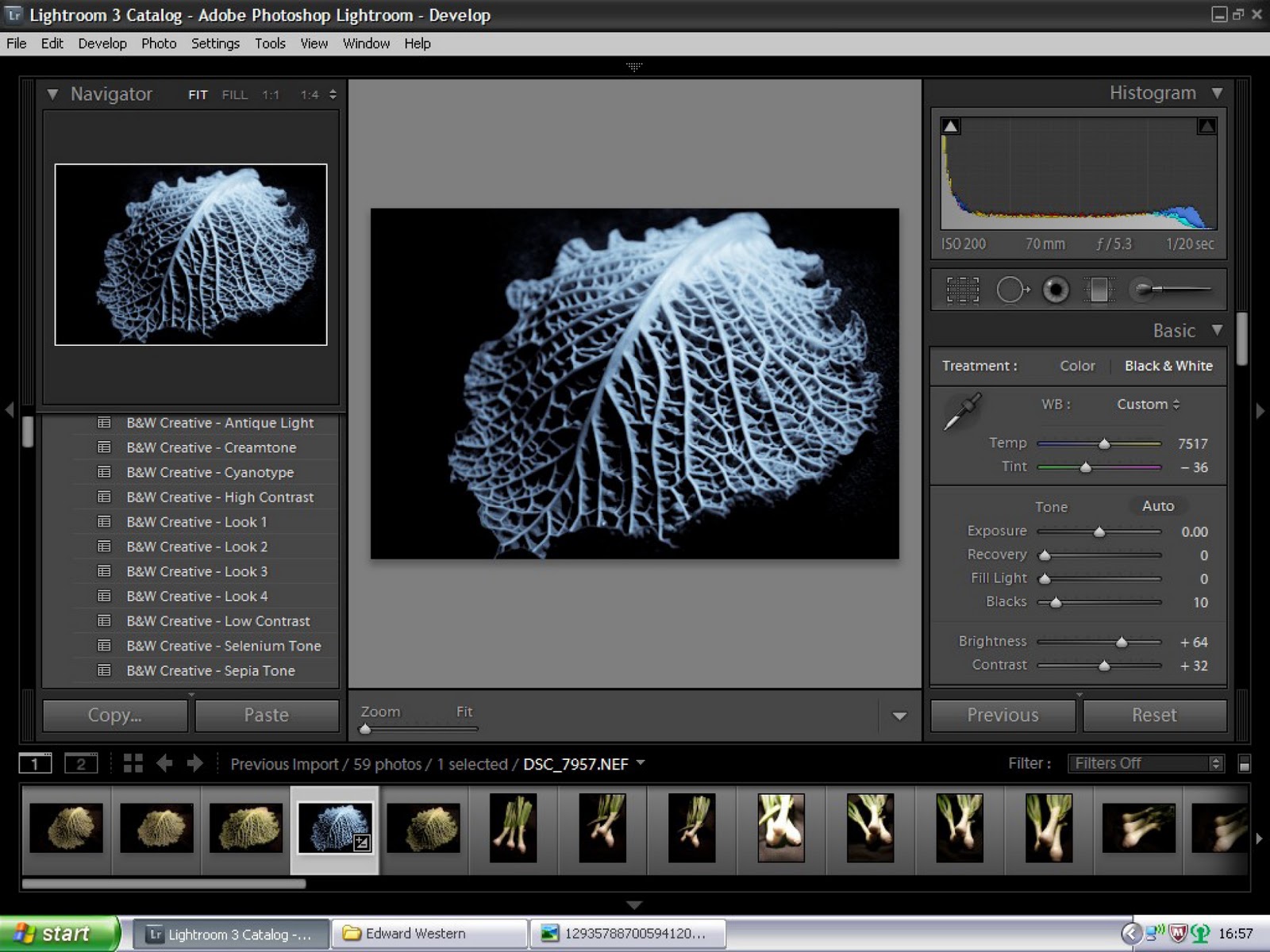
The following screen shots demonstrate how each of the images were manipulated using adobe lightroom:


 All of the inages were shot in RAW to enable the white balance to be adjusted (if necessary) in adobe lightroom. In this instance (cabbage) I used a selenium tone to create the blue tinge. I then boosted the contrast and exported the picture to convert into a JPEG.


This screen shot is demonstrating how I used lightroom to ammend the white balance. The original picture (see below) has a yellow glow due to the light source, and this required alteration.


With all of these 3 images, I wanted to create pictures the were of interest and had different focal points. Each of the objects are common things that are used day in day out, but I wanted to draw the viewers eye to the morse pleasing aspects of the object. The cabbage leaf has hundreds of ridges, that looks almost like an ariel view of a mountain range or a river with all of its tributies feeding off it and flowing into the sea. The tomatoes have such a wonderful colour to them and the vine adds a little more interest to the picture. I very much like contrasting colours which is why I like the black background.

Friday, 31 December 2010

Theme 2 - Final images - Part 1

I have chosen to include the following images in my portfolio:


Specification:

Nikon D300
No Flash
18-70mm lens
Shutter speed 1/10s
f2.8
ISO 200
Focal length 32.00

This image was taken during a Gala dinner at work and I wanted to take a single image to try to represent the whole evening. I felt that Champagne was a great symbol for luxury and extravagance so I decided to take a picture of this. This picture was not tweaked in photoshop, this is how it looked in camera. The only thing that I have done is to resize it.


Specification

Nikon D300
No Flash
Shutter Speed 1/60 sec
f4.0
ISO 1600
Focal length 34.00


This image was taken during the same gala dinner as this image above. The theme of the evening was Autumn and I wanted to try and capture the essence of this in a picture and I felt that the image above demonstrated this nicely. I like the colours of the candle light and the composition. I was unable to use flash as this would have destroyed the soft light. This being the case, I increased my ISO to 1600 to enable me to capture the soft candle light.

Tuesday, 28 December 2010

Theme 2 - Still life - Research - Irving Penn


Irving Penn
American, born 1917
Born in New Jersey,Irving Penn studied design at the Philadelphia Museum School, where he became a student of Alexey Brodovitch. In 1937, the year before he graduated, several of his drawings were published by Harper's Bazaar. From 1940 to 1941, he worked for the art and advertising director of Saks Fifth Avenue, and the following year he spent in Mexico painting, a medium he subsequently abandoned. Returning to New York, Penn was hired by Vogue magazine, first to create ideas for cover illustrations, then to photograph covers as well as editorial illustrations for the interior of the magazine. Working closely with Alexander Liberman, Penn developed a highly stylized, graphically compelling form of fashion photography which did much to define post-war notions of feminine chic and glamour. In his fashion and portrait photography, Penn favored the use of a neutral backdrop of gray or white seamless paper, or alternatively, the use of constructed architectural sets which created striking effects with oblique, diving diagonals and upward tipped perspectives. Penn also created numerous still life compositions for the magazine: carefully orchestrated assemblages of food or objects characterized by a play of three-dimensional and two-dimensional forms. In 1953 Penn opened his own commercial studio and almost immediately became one of the most influential and successful advertising photographers in the world.

Eschewing any notions of naturalism, spontaneity, or chance, Penn has always favored the rigidly controlled, formal conditions of the studio. Thus, even when photographing North African nomads, New Guinea tribesman, Peruvian Indians, or Hell's Angels, Penn contrived portable studios that permitted much the same degree of elegant and structured lighting and composition that he used to photograph fashion models and socialites.

in addition to his fashion and commercial work, Penn has produced a body of art photography. Using platinum and other precious metal processes, Penn has photographed urban detritus (cigarette butts, crumpled wrappers, etc.), the torsos of plump artists' models, and most recently, still lifes of skulls, bones, and construction materials. While the subject matter represents the antithesis of his fashion and commercial work, as does the use of artisanal printing processes produced in numbered editions, both bodies of work reveal the same preoccupation: balance of form and carefully calibrated composition, with nuances of light and tone, presenting a subject that is emotionally neutral or kept always at emotional and psychological arm's length.
Irving Penn studied under Alexey Brodovitch at the Philadelphia Museum School from which he graduated in 1938. Penn's drawings were published by Harper's Bazaar and he also painted. As his career in photography blossomed, he became known for post World War II feminine chic and glamour photography.
Penn has worked for many years doing fashion photography for Vogue magazine. He was among the first photographers to pose subjects against a simple grey or white backdrop and used this simplicity more effectively than other photographers. Expanding his austere studio surroundings, Penn constructed a set of upright angled backdrops, to form a stark, acute corner. Posing his subjects within this tight, unorthodox space, Penn brought an unprecedented sense of drama to his portraits, driving the viewer's focus onto the person and their expression. In many photos, the subjects appeared wedged into the corner. Subjects photographed with this technique included Martha GrahamMarcel DuchampGeorgia O'KeeffeW. H. AudenIgor Stravinsky and Marlene Dietrich.
While a master of the studio flash, most of Penn's portraits are lighted with window light. For travelling to New Guinea and other locations to photograph indigenous people, Penn created a portable studio with a skylight deployed facing north with impressive results. These pictures had the same feel as his portraits of celebrities; fully adorned, naturally lighted, yet placed before the neutral backdrop, his tribal subjects appear as strangely defined models for a 19-century ethnographic investigation.
In 1950, Penn married his favorite model, Lisa Fonssagrives and he founded his studio in 1953. They have one son together, who is named Tom.
Clarity, composition, careful arrangement of objects or people, form, and the use of light characterize Penn's work. Penn also photographs still life objects and found objects in unusual arrangements with great detail and clarity.
While his prints are always clean and clear, Penn's subjects vary widely. Many times his photographs are so ahead of their time that they only came to be appreciated as important works in the modernist canon years after their creation. For example, a series of posed nudes whose physical shapes range from thin to plump were shot in 1949-1950, but were not exhibited until 1980.
His still life compositions are skilfully arranged assemblages of food or objects; at once spare and highly organized, the objects are raised to a graphic perfection, articulating the abstract interplay of line and volume.

Legacy

He has published numerous books including the recent, "A Notebook at Random" which offers a generous selection of photographs, paintings, and documents of his working methods. Penn's wife, Lisa Fonssagrives, died in 1992.


Below are some images that I have created to emulate the point of view and subject matter of Irving Penns work.

Picture 1:

I chose this subject matter because of the colours, shapes and textures they provide. I wanted to create an image of contrasting shapes and textures hence the liquid on the spoon, the lettice's messy and ramdom form, the carrots simple and straight form and the tomatoes round shape. I tried to emulate Penns simple subject choice, focal point and point of view. I like the simplicity of the shot and the clean lines and edges. The slightly embossed paper and the pepper, create just enough distraction.


Picture 2:

This image is even more true to Penns simple approach. I have left out the pepper so it is an even more simple and straight forward image.


The issue with this image is the lack of contrasting colors, all of them apart from the red tomatoes are quite bland. I prefer the top image as it has more definition and contrast in both the texture and the tones.

Picture 3:

This next picture is taken using Penn as an influence as I have diverted away from the view point, favoring a lower line of sight.


Because of the shorter focal length and lower line of sight, there is more detail in the lettuce leaves and in the salt, resting on the spoon.


Theme 2 - Still life research - Jan Groover


Jan Groover was born in Plainfield, New Jersey in 1943. Ms. Groover pursued an education in art receiving her B.F.A. in painting in 1965, from Pratt Institute in New York then receiving her Master's in Art Education from Ohio State University in 1969. After teaching art in junior high school then University of Hartford in the early 1970's, she turned to photography. While she experimented with a range of styles and vision she is perhaps best known for her still life images of ordinary objects, kitchen utensils, plants but taking her images with vibrant color and larger than life close ups. She received grants from New York State Council on the Arts and the National Endowment for the Arts.
Ms. Groover enjoyed a wide range of artistic expression. The larger than life imagery from her photography found expression in platinum-palladium printing, exaggerated images with brilliant color and luminance. She enjoyed writing and published "Pure Invention: The Tabletop Still Life" in 1990. She also taught at the State University of New York College before moving to France where she lives now.
We don't know exactly what led Ms. Groover from a career of formal art to that of photography. She is quoted stating: "With photography I didn't have to make things up, everything was already there."
I was originally attracted to Ms. Groover's photographs for their vibrant color and larger than life imagery. In her life, there is a sharp departure from photographs depicting motion, time, speed, and color to what perhaps she is best known for, simple everyday objects found in the home. One review states 'she turned to her kitchen sink' for new ideas. Many of her photographs depict kitchen utensils, knives, forks, and other subjects found in the home such as bowls, dishes, or house plants.
Her pictures were taken with a 4x5 view camera. Her photographs stressed and illustrated her influence and obedience to formalism. A favorite photograph of mine, "Untitled, 1979. JG #95.2'", has a blend of shapes, curves, and lines that is almost hypnotic and yet when I first looked at it, it was easy for my imagination to see many other things. I see shell, and ancient ruins, and wares of a Roman triumph. Perhaps this is an expression of Ms. Groover's alignment with formalism. Any shape can captivate.
Does any shape have gratifying qualities? Does any shape have special detail when we take the time to observe? The image above accentuates silver and yet we see tarnish drift to iridescence and mirrored reflection.
"According to Groover, the meaning of the objects is of no importance; only the shape, texture, and form that falls into a particular space is important."
What a wonderful tribute to a photographer and a tribute to her art. Her ability to share and see illuminating quality in the most simple of things says much about her vision. When I reviewed Ms. Groover's work, it is easy to mistake some of her photography with her prints. Her photographs possess some of the 'larger than life' color and detail... of a print that was privileged with additional editing. According to one writer, "Groover makes pictures that are interesting not so much for the things they show us as for how they show us these things".

Taking on board Groovers affinity to knives and forks, I created the image below using the following equipment:


1x Nikon D300
1X tripod
1X 50mm lens
Daylight
piece of embossed paper
Knives and forks
Sauce


The knives and forks on their own, I felt were quite uninspiring so I decided to raid the kitchen cupboards and use different coloured sauces to add a different texture,  different colours and a different aspect to the image.